

Pediatric Amoxicillin Dose Calculator by Weight
Use this pediatric amoxicillin dose calculator by weight to convert a clinician's mg/kg/day plan into exact mL for common suspensions, including 400 mg/5 mL, before giving the first dose.
Usual oral amoxicillin dose for children over 3 months: 45 mg/kg per day as 22.5 mg/kg every 12 hours (max 875 mg per dose), or high-dose 90 mg/kg per day for ear infection when prescribed (max 2,000 mg per dose). 40 kg and up: adult dosing. Enter weight for the mL on your bottle; give the dose your child's prescriber ordered.
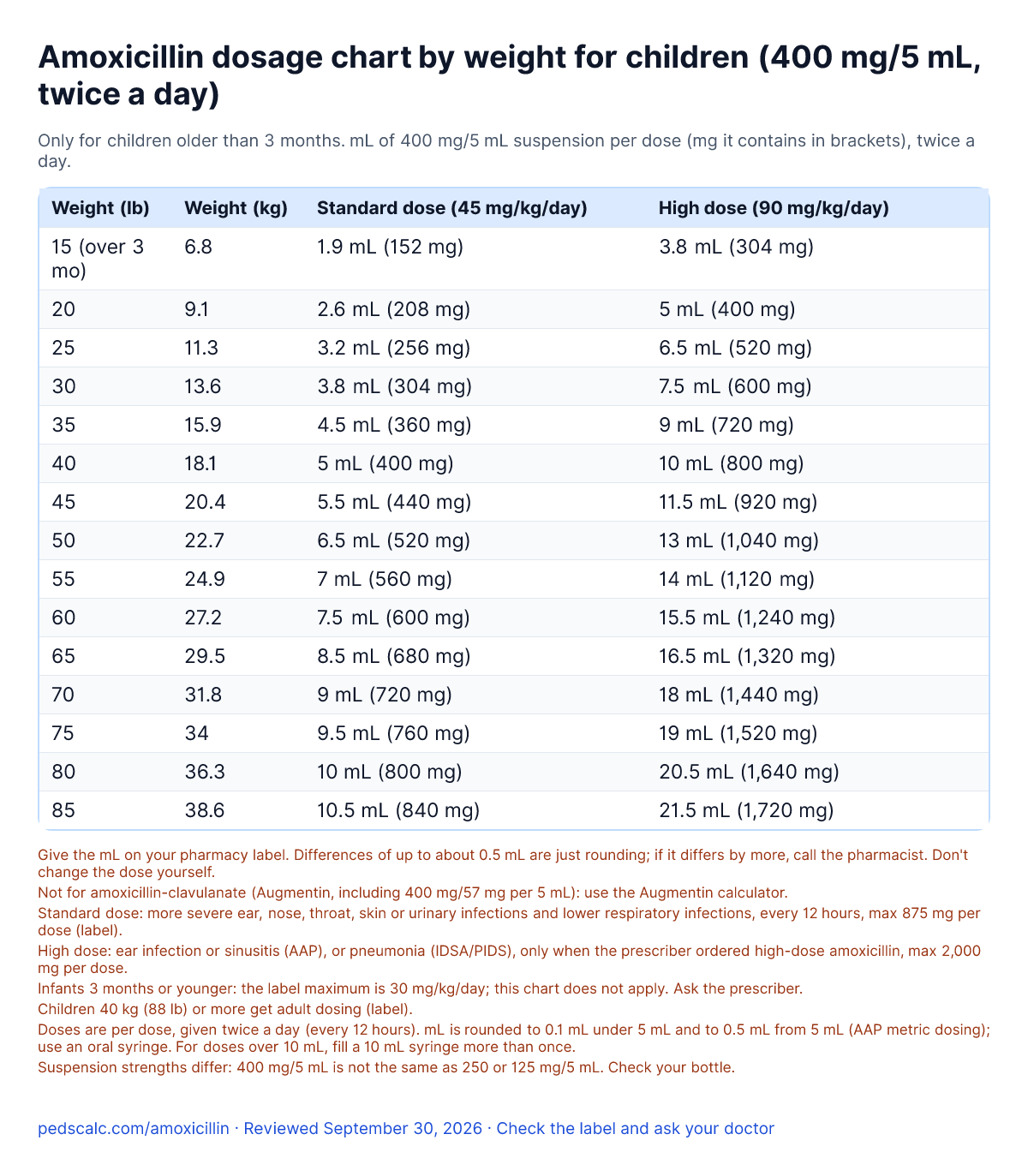
Amoxicillin dosage chart by weight for children (400 mg/5 mL, twice a day)
Only for children older than 3 months. Amoxicillin doses given twice a day with 400 mg/5 mL suspension; use the column that matches the dose your child's prescriber ordered, and the calculator above for other weights or bottle strengths.
- Give the mL on your pharmacy label. Differences of up to about 0.5 mL are just rounding; if it differs by more, call the pharmacist. Don't change the dose yourself.
- Not for amoxicillin-clavulanate (Augmentin, including 400 mg/57 mg per 5 mL): use the Augmentin calculator.
| Weight (lb) | Weight (kg) | Standard dose (45 mg/kg/day)mL of 400 mg/5 mL suspension per dose (mg it contains) | High dose (90 mg/kg/day)mL of 400 mg/5 mL suspension per dose (mg it contains) |
|---|---|---|---|
| 15check age: over 3 months only | 6.8 | 1.9 mL (152 mg) | 3.8 mL (304 mg) |
| 20 | 9.1 | 2.6 mL (208 mg) | 5 mL (400 mg) |
| 25 | 11.3 | 3.2 mL (256 mg) | 6.5 mL (520 mg) |
| 30 | 13.6 | 3.8 mL (304 mg) | 7.5 mL (600 mg) |
| 35 | 15.9 | 4.5 mL (360 mg) | 9 mL (720 mg) |
| 40 | 18.1 | 5 mL (400 mg) | 10 mL (800 mg) |
| 45 | 20.4 | 5.5 mL (440 mg) | 11.5 mL (920 mg) |
| 50 | 22.7 | 6.5 mL (520 mg) | 13 mL (1,040 mg) |
| 55 | 24.9 | 7 mL (560 mg) | 14 mL (1,120 mg) |
| 60 | 27.2 | 7.5 mL (600 mg) | 15.5 mL (1,240 mg) |
| 65 | 29.5 | 8.5 mL (680 mg) | 16.5 mL (1,320 mg) |
| 70 | 31.8 | 9 mL (720 mg) | 18 mL (1,440 mg) |
| 75 | 34 | 9.5 mL (760 mg) | 19 mL (1,520 mg) |
| 80 | 36.3 | 10 mL (800 mg) | 20.5 mL (1,640 mg) |
| 85 | 38.6 | 10.5 mL (840 mg) | 21.5 mL (1,720 mg) |
- Standard dose: more severe ear, nose, throat, skin or urinary infections and lower respiratory infections, every 12 hours, max 875 mg per dose (label).
- High dose: ear infection or sinusitis (AAP), or pneumonia (IDSA/PIDS), only when the prescriber ordered high-dose amoxicillin, max 2,000 mg per dose.
- Infants 3 months or younger: the label maximum is 30 mg/kg/day; this chart does not apply. Ask the prescriber.
- Children 40 kg (88 lb) or more get adult dosing (label).
- Doses are per dose, given twice a day (every 12 hours). mL is rounded to 0.1 mL under 5 mL and to 0.5 mL from 5 mL (AAP metric dosing); use an oral syringe. For doses over 10 mL, fill a 10 mL syringe more than once.
- Suspension strengths differ: 400 mg/5 mL is not the same as 250 or 125 mg/5 mL. Check your bottle.
400 mg/5 mL mL conversion
Amoxicillin dose calculator details for 400 mg/5 mL suspension
Amoxicillin searches often need the plain amoxicillin pediatric dosing by weight answer, not Augmentin. Keep the 400 mg/5 mL bottle visible while converting mg/kg/day plans into a measured mL per dose.
Formula
mL per dose = (child weight in kg x prescribed amoxicillin mg/kg/day / doses per day) / (400 mg / 5 mL).
Worked example
For a 20 kg child prescribed 45 mg/kg/day divided twice daily, the amoxicillin target is 900 mg/day, or 450 mg per dose. With 400 mg/5 mL suspension, that is 5.6 mL per dose.
Safety checks before using the result
- Do not substitute Augmentin for amoxicillin or vice versa without a clinician-specific plan.
- Confirm allergy history and the prescribed maximum daily dose before routine use.
- Recheck the bottle concentration if the pharmacy changes flavor, size, or strength.
Practical dosing guide
Before you measure the dose
Use this page to match the infection, prescribed mg/kg plan, and bottle strength before you measure the first dose.
- 400 mg/5 mL suspension
- This is one of the most common pediatric bottle strengths and often the most practical choice when the plan uses higher mg/kg/day dosing with twice-daily scheduling.
- Ear infection (AOM)
- High-dose amoxicillin is usually 80-90 mg/kg/day divided twice daily when resistant pneumococcus is the concern and there has not been recent amoxicillin exposure.
- Strep throat
- A common plan is 50 mg/kg/day for 10 days, either once daily (max 1,000 mg per day) or divided into two doses (max 500 mg per dose) (CDC).
Amoxicillin pediatric medication summary
Amoxicillin is a common pediatric antibiotic for ear infections, strep throat, sinusitis, and pneumonia. Use the pediatric amoxicillin dose calculator by weight to convert mg/kg/day plans into exact mL for common suspension strengths such as 400 mg/5 mL, including high-dose otitis media dosing.
In children, amoxicillin is used to treat a variety of bacterial infections. Notably, it remains the first-line treatment for acute otitis media (middle ear infection) in kids who have not recently received this antibiotic. It is also a go-to option for streptococcal pharyngitis (strep throat) and is commonly recommended due to its efficacy and palatability for children. Amoxicillin effectively treats many sinus infections and pneumonias in childhood – for example, it is the treatment of choice for typical community-acquired pneumonia in school-aged children, targeting S. pneumoniae. Because it is available as a flavored liquid and is inexpensive, families find it easier to administer, which improves adherence to the treatment regimen. In summary, amoxicillin is a cornerstone of outpatient pediatric antibiotic therapy, providing reliable cure rates for common infections while being generally safe and easy to use in children.
Amoxicillin indications and common pediatric uses
Amoxicillin is a trusted antibiotic that helps children fight bacterial infections. Understanding when and how it's used ensures your child receives the right treatment at the right time for their infection.
Acute Otitis Media (Middle Ear Infection)
Acute Otitis Media (Middle Ear Infection): Amoxicillin remains the first-line antibiotic for most acute otitis media cases in children without recent amoxicillin exposure
Streptococcal Pharyngitis (Strep Throat)
Streptococcal Pharyngitis (Strep Throat): Recommended as a first-line therapy (along with penicillin) for confirmed group A strep throat due to its narrow spectrum and safety
Acute Bacterial Sinusitis
Acute Bacterial Sinusitis: Amoxicillin (alone or with clavulanate) remains first-line therapy for uncomplicated bacterial sinusitis in children
Community-Acquired Pneumonia (Typical)
Community-Acquired Pneumonia (Typical): Treatment of choice for outpatient pneumonia in children, providing coverage against common bacterial causes like pneumococcus.
Early Lyme Disease (Erythema Migrans)
Early Lyme Disease (Erythema Migrans): Recommended antibiotic for Lyme disease in young children to avoid tetracyclines (doxycycline is avoided under 8 years).
Post-exposure prophylaxis for anthrax (Bacillus anthracis)
Post-exposure prophylaxis for anthrax (Bacillus anthracis): Used when tetracyclines and fluoroquinolones are contraindicated; combine with additional agents per CDC recommendations.
How to give Amoxicillin
- Amoxicillin is a widely-used antibiotic that's generally easy to administer to children due to its pleasant taste and flexible dosing options. Understanding proper administration techniques ensures your child receives the full benefit of this important medication.
- Shake the suspension vigorously for at least 10 seconds before every dose, draw the exact volume with the pharmacy syringe, and give it immediately—never pour it into a bottle where the full dose may not be finished. Space doses evenly (every 12 hours for BID, every 8 hours for TID) and aim for routines like breakfast/bedtime so levels stay therapeutic. If tablets are prescribed for older children, have them swallow with water or mix crushed tablets into a spoonful of soft food right before dosing.
- Label the bottle with the dose in both mg and mL, set phone alarms for each administration, and keep a simple log so multiple caregivers do not double-dose. Store the suspension in the refrigerator door in a dedicated basket with the syringe, swirl gently if it sits out briefly, and plan ahead for school or daycare doses by sending a cold pack and written instructions. Call if vomiting occurs within 15 minutes or if more than two doses are missed—your pediatrician can help reset the schedule safely.
- infant
- toddler
Amoxicillin side effects, contraindications, and interactions
Most amoxicillin side effects in children are mild and self-limited, but safe care depends on structured monitoring, early recognition of red flags, and fast escalation when symptoms change trajectory.
Common side effects
- Gastrointestinal upset: Mild diarrhea, nausea, or occasional vomiting can occur as gut bacteria change. Encourage fluids and consider probiotics if advised by your clinician.
- Skin rash: A flat pink rash can occur during treatment and is often not a true allergy. Hives, swelling, or breathing difficulty are emergency signs.
- Yeast overgrowth: Infants and toddlers can develop diaper rash or oral thrush after antibiotics. Report white patches or persistent diaper rash to your clinician.
- Gastrointestinal upset (diarrhea, nausea, vomiting)
- Non-allergic maculopapular rash
Safety checks
- Documented immediate hypersensitivity to amoxicillin or other penicillins
- Confirmed or strongly suspected infectious mononucleosis (due to predictable rash)
- History of severe immediate reaction to any penicillin (anaphylaxis, angioedema, Stevens-Johnson syndrome)
- Severe renal impairment (creatinine clearance <30 mL/min) without appropriate dose adjustment
- Prior Clostridioides difficile or antibiotic-associated colitis
- Phenylketonuria when only phenylalanine-containing formulations are available
Drug interactions
- Review the full medication list with a clinician or pharmacist before combining therapies.
Amoxicillin mechanism and clinical pearls
Amoxicillin works by going after bacterial cell wall construction proteins, especially penicillin-binding proteins (PBPs). It makes it harder for bacteria to build and repair the wall that protects them from bursting. That is why it can be bactericidal: over time, with the right dosing interval, bacterial cells become structurally unable to survive. Amoxicillin doesn’t target human cells for the same reason—they do not depend on peptidoglycan wall synthesis.
For acute otitis media, 80-90 mg/kg/day split BID is still the default when you suspect resistant pneumococcus.
When evidence supports it, BID dosing is usually easier for parents to sustain than TID, and families report better completion rates.
If a child with mono develops a diffuse, non-urticarial rash, document timing and pattern before calling it a penicillin allergy.
Palatability is usually the difference between a completed treatment course and a half-dosed one.
High-dose amoxicillin (80-90 mg/kg/day) is now standard first-line therapy for acute otitis media
Frequently asked questions about Amoxicillin
Amoxicillin is dosed by weight in mg/kg/day and divided into 2 or 3 doses depending on the infection. Use the calculator with the prescribed mg/kg/day target to convert weight into an accurate mL dose for the suspension strength.
Use the prescribed mg/kg/day target first, then let the calculator convert that into mL for the 400 mg/5 mL bottle. That is especially helpful when the plan is a higher-dose otitis media regimen and you want to avoid manual suspension math.
Ear infection plans often use a higher amoxicillin range such as 80-90 mg/kg/day divided twice daily, while strep throat is commonly treated with 50 mg/kg/day for 10 days. The calculator helps convert the clinician's chosen mg/kg target into the right mL for the bottle in your hand.
The 400 mg/5 mL suspension packs more amoxicillin into each milliliter, so high-dose plans for otitis media or sinusitis can be given in a smaller, more practical volume. The prescription still starts with the mg/kg/day target, then the calculator converts it into mL for that specific concentration.
Amoxicillin treats bacterial infections commonly seen in children. For example, it is often prescribed for ear infections (otitis media), strep throat (streptococcal pharyngitis), sinus infections, and certain pneumonias. It’s also used for some less common issues like infected animal bites or as part of therapy for Lyme disease in young kids. Importantly, amoxicillin works against bacteria – it will not help viral illnesses like colds or the flu. Doctors choose amoxicillin when they believe a child’s infection is caused by bacteria that are known to respond well to this medication.
Typically, children start to improve within 48 to 72 hours after starting amoxicillin. For instance, fever and pain often decrease significantly by the third day of treatment as the antibiotic curbs the infection. In conditions like strep throat, children might feel improvement in as soon as 24–48 hours. That said, it’s important to continue the medication for the full prescribed duration even if they seem back to normal. If your child has been on amoxicillin for 3 days with no improvement or if symptoms are worsening, you should contact the pediatrician – the infection may be resistant or caused by something else. Always complete the entire course to ensure the infection is fully treated.
If you miss a dose, give it as soon as you remember unless it’s almost time for the next dose – if the next scheduled dose is soon, skip the missed dose and just continue with the regular schedule. Do not give a double dose to make up for the missed one. If your child vomits or spits out a dose right away, consult your provider’s guidance; often, if a child vomits within 15 minutes of taking the medicine, it’s reasonable to repeat the dose (since the medication probably didn’t get absorbed). If it’s been longer, or you’re not sure, call the pediatrician or pharmacist for advice. To prevent spit-ups, you can try giving the medicine slowly and in a relaxed environment, perhaps followed by a small drink or snack that the child likes (to help with the taste).
The most common side effects are mild digestive issues – think diarrhea, loose stool, mild stomach upset, or occasional vomiting. These usually can be managed at home: keep your child hydrated and consider giving probiotic-rich foods like yogurt to help restore gut balance. Another common side effect is a skin rash. If a rash occurs, note what it looks like – a flat, blotchy rash that isn’t itchy and comes a few days into treatment can happen (especially if your child has a viral infection along with the bacterial one). You should still inform the doctor, but this type of rash is often not serious. However, if you see hives (raised bumps) or any itching, swelling, or breathing problems, that could be an allergic reaction – stop the medication and seek medical care immediately. Overall, most kids tolerate amoxicillin very well. If you’re ever unsure about a symptom your child develops during treatment, reach out to the healthcare provider to be safe.
Not necessarily. Amoxicillin can cause two types of rashes. One is an allergic rash – usually hives or red patches that appear soon (within minutes to a couple of hours) after a dose, often with itching. That kind of rash, especially if joined by other allergy symptoms, means you should stop the drug and treat it as a potential allergy. However, there is another rash type – a non-allergic amoxicillin rash – which often occurs around the 3rd to 5th day of treatment. This rash is typically flat or maculopapular (flat with some small raised areas), and it’s not itchy or dangerous. For example, if a child has mononucleosis (EBV infection) and takes amoxicillin, they almost always get a pronounced pink rash all over (even though they aren’t truly allergic to the medication). That rash will go away on its own and isn’t a lifelong allergy; it’s a reaction between the virus and the drug. It’s important to let your doctor evaluate any rash. They may ask questions about timing and appearance to decide if it’s likely an allergy. Never re-dose amoxicillin after a suspected allergic rash until a doctor says it’s okay. If it was a non-allergic rash, your child may still be able to take penicillin-type antibiotics in the future, but this determination should be made by a healthcare professional (sometimes allergy testing is done to be sure).
Yes. It’s very important for your child to complete the full prescribed course of amoxicillin, even if symptoms resolve before it’s finished. Stopping an antibiotic early can lead to the infection not being fully eradicated. The remaining bacteria might multiply and potentially become resistant to the antibiotic. By finishing the course, you ensure that all the bacteria causing the illness are killed and reduce the chance of the infection coming back or bacteria developing resistance. If your pediatrician tells you to stop early (in rare cases they might if they determine the infection is not bacterial or a different treatment is needed), then follow their guidance. But don’t save leftover antibiotic for future use, and don’t stop just because the child feels okay. Completing the full course is a key part of effective treatment and stewardship.
Sources reviewed for Amoxicillin
FDA Approved Labeling for Amoxicillin
SourcePediatric Acute Otitis Media (Middle Ear Infection) Treatment Guidelines
SourcePediatric Streptococcal Pharyngitis (Strep Throat) Treatment Guidelines
SourcePediatric Acute Bacterial Sinusitis Treatment Guidelines
SourcePediatric Community-Acquired Pneumonia (Typical) Treatment Guidelines
SourcePediatric Early Lyme Disease (Erythema Migrans) Treatment Guidelines
Source